Body Armour UK Logo
Body Armour UK address
Body Armour Centre Logo

Knife / Stab Protection Levels

Home Office Scientific Development Branch (HOSDB)

Any product with the word “Knife” in our price tables will offer “reasonable to good” resistance to a direct blade attack - even if it is a “ballistic only” vest. For situations where a risk assessment has concluded a “risk to life” from bladed or pointed weapons, then we formally recommend a specification that contains the phrase “Spike” in any price table.

Knives that pose the most serious threat to armour systems are termed “engineered”. This in Plain English means a blade type that when slammed into a wooden block, would retain its shape and pointed effectiveness to be capable of being used again in its original, relatively undamaged state.

If you were to examine most kitchen knives, you would realise that these “drawer knives” do not really qualify for inclusion. Slamming a bread knife into a wooden surface would probably snap the blade. In fact, most household knifes will bend if presented with any degree of force. The instant a Knife starts to bend is the physical energy point where the weapon looses its penetration potential.

In contrast to the above, knives purchased from specialist shops are quite different - they are made of high grade steel and drop into the “engineered” category. They are capable of retaining their shape at maximum human impact energy. Such blade types are what body armour systems must resist to qualify for certification. The newest test blade in the UK 2003 Police standard is just such a blade - with a pin sharp tip, and absolutely “no give” in its construction.

The Spike (like an ice pick) test (SP1, SP2 & SP3) is considerably more severe than the knife test. When the Spike test was first introduced, we sent all our current stab systems for evaluation. Everything failed at the SP1 level. We changed all material systems to qualify for this new standard immediately afterwards. The fact that we changed all our systems is no detriment to BODYARMOUR UK, all major suppliers had the same problem. Some other suppliers materials simply could not pass this test, which is why so few suppliers offer Spike Resistant Systems.

BODYARMOUR UK - Stab Protection Levels Table

Important - This table relates to the current HOSDB 2003 (Police Standard) The Anti-Stab is produced in accordance with the PSDB Stab 1993 Standard. At first glance the Anti-Stab might appear superior to the KR1+SP1 - it is less capable than the 1999 KR1 & 2003 KR1 standard. We deliberately downgraded its name from KR25 to Anti-Stab to avoid misleading our customers.

UK Knife Protection Levels

Impact Energy Strike 1

Impact Energy Strike 2

Protection
Level

UK Police
Test Weapon

Joules

ft*lbf

Penetration
Max (mm)

Joules

ft*lbf

Penetration
Max (mm)

Anti-Stab

3 Inch Bowie Knife (L113)

25

18.4

5

Impacts at Energy 1 Strike + 50% (Energy Strike 2) were not introduced until 1999

6 Inch Bowie Knife (L104)

KR1+SP1

Engineered Blade (P1/B)

24

17.7

7

36

26.5

20

Engineered Spike (SP/B)

Nil

Nil

KR2+SP2

Engineered Blade (P1/B)

33

24.3

7

50

36.8

20

Engineered Spike (SP/B)

Nil

Nil

KR3+SP3

Engineered Blade (P1/B)

43

31.7

7

65

47.9

20

Engineered Spike (SP/B)

Nil

Nil

Anti-Stab, Protection from most Knife Threats

This protection level is made in accordance with the PSDB (1993) stab procedure to a 25 Joule energy strike. We call it Anti-Stab to avoid any confusion when comparing it with our newer standards. To call the vest KR25 might give the impression that it is more capable than KR1 (24 Joule). The 1993 stab standard was revised in 1999, and again in 2003. Prior to 1999 we called this a KR25
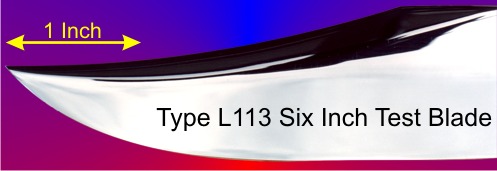
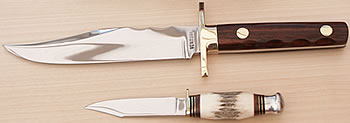
The Anti-Stab protection level protects from most stab threats from larger cross-sectional blades. The test blades for this system are shown above right, and represent typical high quality engineered knives that might be used by an assailant. The 1993 standard was the first knife standard introduced in the UK.
The Anti-Stab system protects from knife attack, slashes, broken bottles and the trauma from physical assault.
Protection systems made in the Anti-Stab standard are considerably less expensive than our newer systems listed below and offer excellent protection from bladed weapons.

two_knives

For most general security duties the Anti-Stab level provides excellent protection. It will resist the type of weapons shown above - The L113 & L104 (PSDB 1993) Test Blades.

Contrary to popular belief - the bigger the knife, the easier it is for body armour to resist its penetration. This is the reason our newest protection materials concentrate on smaller cross-sectional weapons.

We make this body armour from the same material as our bomb blast blankets. In January 2006 we tested the vest to reveal a very impressive V50 result of F1, which is a steel fragment strike at a supersonic 400 metres per second. Personnel who remove land mines are generally supplied with 460m/s systems.

We also ran some low threat ballistic trials against this anti-stab body armour. We reported a .38 Special at 200m/s and a .45 Colt at 180m/s.
Whilst the above is better than nothing, it is not good enough for us to report any credible claim to a ballistic vest. The V50 of 400 m/s (F1) however is exceptionally good in a World where terrorism is a constant concern to us all. Fragmentation levels of 240m/s are used in police bomb search visors. Face visors capable of stopping handgun bullets are rated at 600m/s


KR1+SP1 - Protects against - Knives, Slashing, Spiked Weapons & Hypodermic Syringes

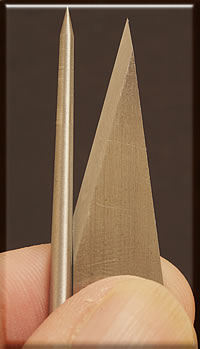
A 2003 Police Standard to protect from pointed weapons and knives. KR signifies "Knife resistance" and SP indicates "Spike Resistance". The picture below (left) shows both test weapons. The spike can be compared to "Ice Pick" or any weapon ground to a point. The material we use to produce our SP systems are also impermeable to attack from hypodermic syringes.
The system offers superb protection to all edged, pointed and sharp weapon attacks. KR1+SP1 offers superior protection to the 1999 KR1 and the 2003 KR1 knife only standards. The system is constructed of multi-layered flexible fabric and contains no solid plates. It can be combined with our HG1 and HG2 ballistic armours to offer dual purpose protection. Spike resistant armours have become necessary due to evolutionary threats from assailants armed with improvised pointed weapons and syringes. Syringes are becoming an increasing menace. Many enquiries we receive are more concerned with syringes than a threat from a knife. The threat of AIDS and Hepatitis are well documented, less well known is that an air bubble injected into the bloodstream from an empty syringe can result in near instant fatality.

P1B Blade & Spike

Shown left are the 2003 Police Test Weapons. The Spike is easily capable of penetrating most current issue police stab armour in levels KR1, KR2 & KR3 at the 24 Joule strike level.
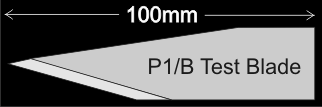
The Blade shown left is a modified sharper version of the 1999 blade. It is worth noting that a 2003 spec KR1 is quite superior to a 1999 KR1.

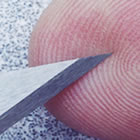
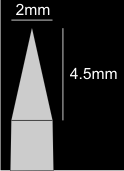
Below is the P1/B Engineered Blade tip shown against a fingertip.

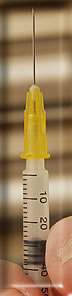
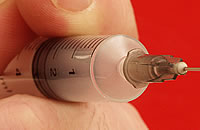
Right - typipical hypodermic syringe - easily stopped by our SP rated systems.

P1/B Test Blade
Hypodermic Syringe

KR2+SP2 - Protects against - Knives, Slashing, Spiked Weapons & Hypodermic Syringes in a high risk environment

syringe2

Using the same material system as the KR1+SP1 with an increased resistance of 33 Joules against a P1/B blade and a spike. This level of protection is better suited to our overt styles of armour because of increased thickness and reduced flexibility.
The level is suited to occupational risks which are greater than occasional. Confrontations on a regular basis in high crime areas might warrant this specification - example Police "Stop and Search" duties in districts with a known weapons carrying culture.
For a general purpose stab / syringe vest, KR1+SP1 is generally preferable.

KR3+SP3 - Protects against - Knives, Slashing, Spiked Weapons & Hypodermic Syringes in an extreme risk environment

Requests for this specification are virtually nil compared to the above protection types. The KR3+SP3 is generally purchased in overt styles for a very specific purpose. It is the type of item that a police station might hold in small quantities to deal with situations of disarming with reasonable advance notice
This specification is usually purchased with the intention of occasional use in a potentially life threatening situation. Risk assessments recommending this protection level are relatively rare. Our sales of this level are less than all our other protection levels combined.

Important

Hypodermic Syringes are not included in the HOSDB 2003, or previous Standards. They are also omitted from the BS EN 388 Standard, which we respectfully deem relevant.
We state that the fabric used in our SP rated armour offers a syringe resistance far in access of any other flexible fabric available today. The fabric uses a “Silicon Carbide” coating on an aramid fibre base, and has been tested by one of the World’s most prominent and respected armour fabric producers. The Company producing this fabric certifies a resistance classed as “Impermeable to Syringe”. This statement is based on their credible production of a respectable “Syringe Drop Test” based on current stab test procedures.
We will be more than happy to refer concerned buyers to files and technical criteria should they question our stated levels.

BODYARMOUR UK uses test facilities approved by HOSDB (Formerly PSDB) to evaluate our stab systems prior to release for sale. We test our stab vests at “Defence College of Management and Technology” at Shrivenham, which is the only UK HOSDB approved test facility. We also test our system “In House” before this test procedure to ensure we will attain the the result our customers expect.

Interesting

Most people are aware of the new SIA body which regulates security personnel in the UK. The SIA runs courses for door staff on a nation-wide basis. We have sent a number of our Anti-Stab vests in Police Covert Style for evaluation this year. The feedback is exactly what we already know.

Our Anti-Stab vest is practically impossible to stab though. Since 1998 no person has ever manually stabbed a knife of any description through this product, even under a perfect strike conditions (and even though it’s our lowest spec vest). The vests were sent to www.asp-uk.com in April 2005 for circulation amongst SIA courses. The vests have a bonus point - he (or she) that manages to stab through it, gets a new one free.

Today the offer of the new vest still stands.

What’s a Joule of Energy?

A Joule is an energy level that realistically does not mean much to anybody except a physicist. A camera flash and steel toed boots and even food calories can be measured in Joules. We have placed a column in our level table of “Foot Pounds Force”. This column relates to dropping a one pound weight from the quoted height in feet. The calculation also appears in several other tables in this site.
The force column gives a practical & relational idea of the “Punch Power” of a Joule. A rough estimation is a regular tin of beans or soup - a free-fall drop from the quoted column height (in feet) will result in an energy level of the listed Joules.
The calculation is our approximation (London Gravity and Vacuum drop) and omits atmospheric resistance. We would expect the height figures to be slightly greater than listed.

Bigger the knife - Worse the Injury?

A large object penetrating a human body will cause significant or fatal injury. Any person confronted with a “RAMBO” style knife would not risk a conflict situation for obvious reasons - anything but perfect judgement might prove terminal. Compare this to a small blade of 2 inches or so; the “Cavalier” might take the risk of confrontation if he thought himself “fitter and faster” than the opponent.

When body armour is worn, a reverse scenario is apparent. Penetrating a resistant surface to reach a easily penetrative surface is difficult in the opposite sense. Consider this:

  1. Knock a six inch nail in wood - try a drawing pin using the same force
  2. Drill a half inch hole in concrete - you will need to use a pilot (small) drill first
  3. Damage a new wooden floor - an elephant causes less damage than a woman’s high heels
  4. Puncture a car tyre with almost any knife - an ice pick type type weapon would be required
  5. Break glass - hard pointed weapons will shatter - fists and feet may have little or no effect

The list demonstrates a contradiction of what is termed a “threat”. The cross sectional area of a weapon is inversely proportional to the actual threat from any given weapon. Essentially this implies the risk of injury from a large weapon is less than that of a  small weapon, if a protective surface covers the strike area.

The above is factual. It is physically demonstrable, but seems to contradict common sense.

Any person faced with a large weapon will naturally fear an immediate threat to life. The good news is our body armour is geared to resist the worst scenario - a small engineered blade with a ultra sharp tip.

Essentially, the bigger the knife - the less chance of it penetrating any body armour.

The material and images on this site are copyright protected. You may print, store or retain information for personal use, but it is not to be sold or used for any commercial purpose without our written consent. © 1998-2008 BODY ARMOUR UK

Prices on this site are shown ex vat & inc vat. Delivery is free on orders over £100 exclusive of VAT

card_logos
[Home] [Civilian] [Under Shirt] [Over Shirt] [Dual Purpose] [Helmets] [Plates] [Specialised] [Shields] [Standards] [UK Stab] [UK Ballistic] [NIJ Ballistic] [Utility] [Gloves] [Ordering] [Contact]